
|
|
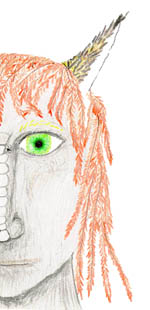 Pharlans appear to be,
at first glance, a combination of humans and birds.
Neither is true as they are completely unique from any
terran species and from anyother group of animals on their
own home planet. Except for the chest area, they are nearly
completely covered with feather-like scales and scales. On t
he head there are true feathers. Their pointed cat-like ears sit
on top of their heads, affording excellent hearing.
Each of the five fingers and three toes has a sharp curving talon. Those
on the fingers are flattened laterally and serrated, while those on the
thumb and toes are rounded. The eyes are proportionately slightly larger
than those of humans and near the eye is the accessory nasal passage which
is used to increase airflow when flying and especially in high speed dives.
Scales cover the upper surface of the nose. They have a short bird-like tail
which increases their maneuverability in flight considerably.
Pharlans appear to be,
at first glance, a combination of humans and birds.
Neither is true as they are completely unique from any
terran species and from anyother group of animals on their
own home planet. Except for the chest area, they are nearly
completely covered with feather-like scales and scales. On t
he head there are true feathers. Their pointed cat-like ears sit
on top of their heads, affording excellent hearing.
Each of the five fingers and three toes has a sharp curving talon. Those
on the fingers are flattened laterally and serrated, while those on the
thumb and toes are rounded. The eyes are proportionately slightly larger
than those of humans and near the eye is the accessory nasal passage which
is used to increase airflow when flying and especially in high speed dives.
Scales cover the upper surface of the nose. They have a short bird-like tail
which increases their maneuverability in flight considerably. Sexual dimorphism is quite subtle in Pharlans. Males and Females are similar in size and strength with males being slightly shorter and stockier with emales being taller and thinner. Sexual maturity is reached around 250 years of age while approximate full size is reached around thirty. Pharlans pair off at around 300 to 400 years of age. The young are hatched from relatively small eggs that are expandable and grow in size by absorbing solar radiation and energy from the parents. When a pharlan first hatches it is dependent on energy alone to sustain it. Within 24-36 hours it will be able to digest food and obtain energy from it but until that time the parents must consume large quantities of food to convert into energy for the hatchling.
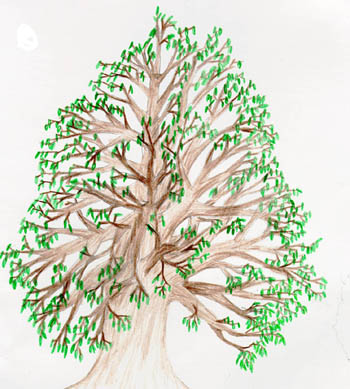 The king tee is a very large tree. It can
be up to 500 ft in height and can be tens of thousands of years old. It's life and
reproduction are closely intertwined with that of the Pharlans.
The king tee is a very large tree. It can
be up to 500 ft in height and can be tens of thousands of years old. It's life and
reproduction are closely intertwined with that of the Pharlans.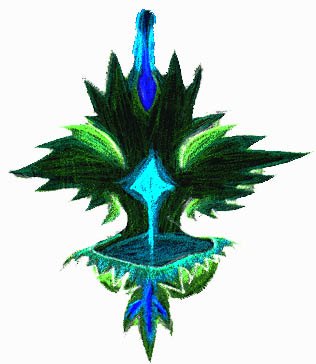 At right is the flower of the king tree.
It produces a glowing light that attracts Pharlans as well as a sweet scent.
At right is the flower of the king tree.
It produces a glowing light that attracts Pharlans as well as a sweet scent.